
From Project Management to Delivery Leadership: Lessons from Large, Multi-Stakeholder Programs
Project management delivers outputs. Delivery leadership ensures outcomes.
Article 3 • 19 Jan
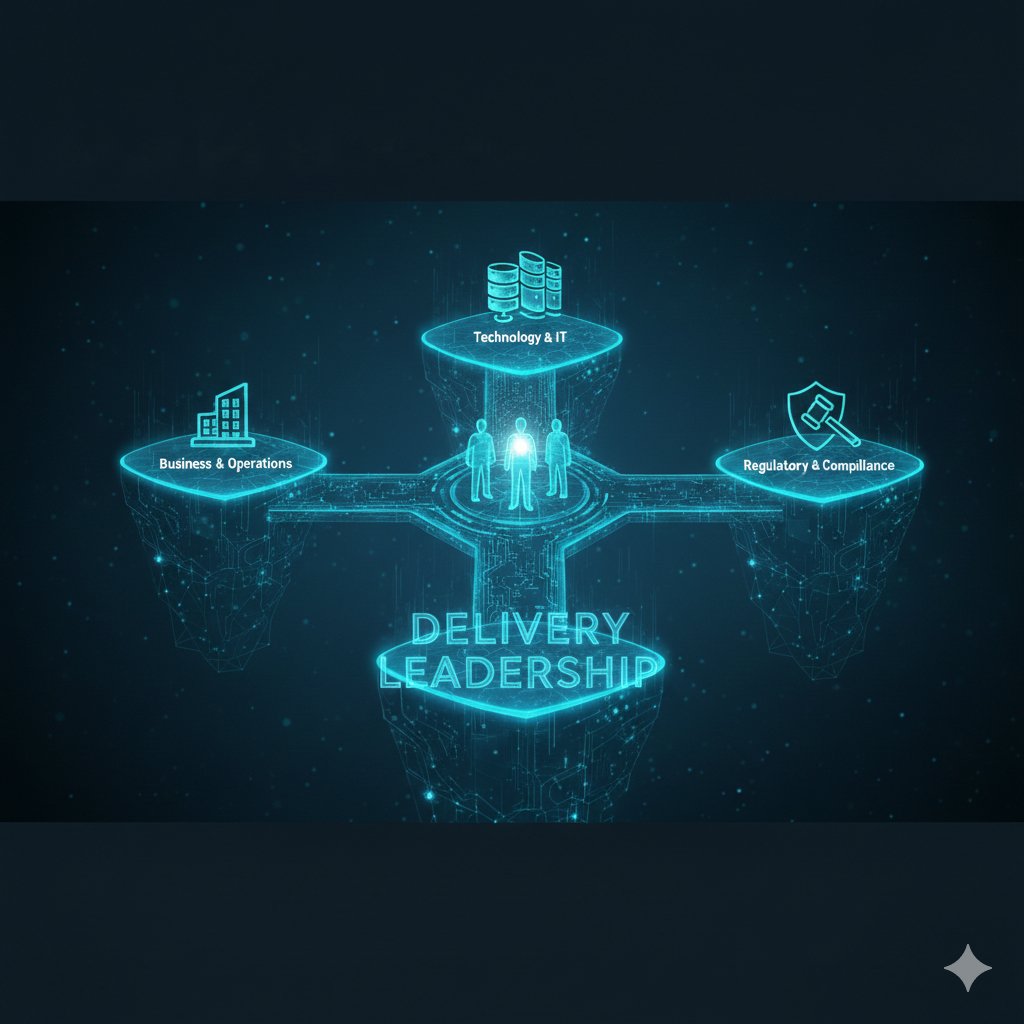
Early in my career, I believed strong delivery meant mastering plans, schedules, and reporting. Those skills still matter — but experience teaches you that delivery leadership is about much more than execution mechanics.
It’s about navigating complexity that doesn’t fit neatly into a plan.
Projects end. Delivery outcomes live on.
In consulting and enterprise roles, I’ve seen projects technically “complete” while outcomes struggled post-go-live. True delivery leadership considers:
- Operational readiness
- Regulatory sustainability
- Business adoption
- Support and ownership models
This becomes especially clear in finance and insurance transformations, where regulatory and audit obligations extend long after implementation.
Delivery leaders operate across boundaries
Large programs don’t fail because one team makes a mistake. They fail when boundaries aren’t managed:
- Business vs IT
- Vendor vs internal teams
- Regional vs local stakeholders
Effective delivery leadership creates alignment mechanisms, not just schedules. Alignment beats control.
Leadership shows up most when certainty disappears
The defining moments of delivery leadership are rarely in steady-state execution. They appear when:
- Assumptions break
- Timelines compress
- External constraints change
In those moments, teams look to delivery leaders not for answers, but for direction, calm, and prioritization. That’s where experience matters most.
Closing thought
Project management delivers outputs. Delivery leadership ensures outcomes. And in complex, regulated, multi-stakeholder environments, that distinction makes all the difference.
Article details
- Category: Delivery Leadership
- Tags: Outcomes, Readiness, Alignment
- Previous: Discipline over frameworks
- Next: Leading in regulated environments